“Asana is not the art of making shapes; it is the art of making the body truthful enough to house stillness.” — Aroonji
Many people in the modern world meet yoga through movement. They come through the doorway of stretching, flexibility, mobility, fitness, injury prevention, or perhaps beauty. But in Patañjali’s map, āsana is not the first limb, nor the whole tree. It is the third limb, placed after Yama and Niyama, as though the sages were whispering: before the body becomes expressive, life must become ethical and inwardly tended. In Yoga Sutra 2.29, Patañjali names āsana as the third of the eight limbs. (Shlokam)
And then something astonishing happens: in the Yoga Sutra, āsana receives only three terse verses—2.46, 2.47, and 2.48. No grand catalogue of poses. No acrobatic hierarchy. No spiritual trophies. Instead, Patañjali defines āsana through quality, attitude, and consequence: steadiness, ease, relaxation of effort, and freedom from disturbance by the pairs of opposites. (Shlokam)
The first of these is perhaps the most quoted line in all of yoga:
स्थिरसुखम् आसनम्
sthira-sukham āsanam
Āsana is steady and easeful. (Shlokam)
This is not a small teaching. It is a complete revolution.
A posture is not truly yogic because it is advanced. It is yogic because it is steady without becoming hard, and easeful without becoming lazy. A mountain gives us the first half of the teaching: rooted, present, unwavering. A river gives us the second: flowing, adaptable, unforced. Real āsana is mountain-and-river together.
So much of modern life trains us into the opposite. We become rigid in our ambition and collapsed in our exhaustion. We sit with the spine like a question mark over a laptop. We stand with the jaw clenched in supermarket lines. We scroll with the neck hanging like a wilted flower toward the phone. Then we come to a yoga class and try to “achieve” peace through force. But force is not the doorway Patañjali names. He points instead toward a body that has learned the rare art of poised belonging. That is why āsana matters: it teaches the body not merely to perform, but to participate in consciousness.
The second sutra deepens the mystery:
प्रयत्नशैथिल्यानन्तसमापत्तिभ्याम्
prayatna-śaithilya-ananta-samāpattibhyām
Āsana is refined through the relaxation of excess effort and absorption in the limitless. (Shlokam)
This is so subtle, and so easily missed. Yoga does not say, “Try harder until posture becomes pure.” It says: relax the unnecessary effort. Release the gripping. Loosen the noise in the muscles, the vanity in the mind, the ambition in the breath. Then let attention widen into something vast—ananta, the limitless, the unbounded. (Shlokam)
A bird crossing the Tuscan sky does not flap with panic the whole way. At a certain point, it lets the current carry it. In the same way, mature āsana is not a wrestling match with the body. It is intelligent participation. Not collapse. Not strain. A wise yielding inside a clear structure.
And then Patañjali gives the fruit:
ततो द्वन्द्वानभिघातः
tato dvandvānabhighātaḥ
Then one is no longer troubled by the pairs of opposites.
Heat and cold. Effort and fatigue. praise and blame. success and disappointment. stiffness and flexibility. This sutra is often read physically, but it is larger than that. When āsana matures, we are less bullied by extremes. The body becomes less reactive; the mind becomes less dramatic. We stop being tossed around by every little inner weather pattern. Āsana, in this sense, is not just posture. It is training in embodied equanimity. (Shlokam)
The Bhagavad Gītā enriches this understanding beautifully. In 6.11–12, Krishna advises the practitioner to establish a steady seat in a clean place, neither too high nor too low, and to sit there with a collected mind for inner purification. Later haṭha tradition broadens the field further: Haṭha Pradīpikā 1.17 says that āsana brings steadiness, health, and lightness of limb. So the classical stream is not one note only. Patañjali emphasizes meditative stability; the Gītā emphasizes the conditions for collected sitting; the Haṭha text emphasizes steadiness, health, and lightness. Together they form a full-bodied picture. (Shlokam)
Why āsana is important
Why is āsana so important? Because the body is not separate from the mind we are trying to calm.
A restless body can become a drum that the mind keeps striking. A collapsed body can become a room with no windows, and a strained body can become a room full of alarms. Āsana is the gradual art of making the body into a lamp: stable at the base, open at the top, and able to hold a flame without shaking.
Without āsana, spirituality often remains abstract. We speak of peace while the shoulders live near the ears. We speak of surrender while the belly is armored. We speak of awareness while the breath is trapped in the upper chest. Āsana brings philosophy into tissue. It asks: can your spine learn what your mouth keeps saying? Can your breath embody what your ideals admire?
This is why āsana is not superficial. It is not “just physical.” The body is the visible shore of the invisible self. If the shore is storming, meditation becomes harder. If the shore becomes quiet, subtler boats can land there.
What āsana is not
Āsana is not punishment dressed as discipline.
It is not self-violence with Sanskrit names.
It is not a performance of spiritual worthiness.
It is not the worship of flexibility.
It is not a theater of comparison.
A person touching their toes while holding their breath, tightening the face, and secretly thinking, I must go deeper than the others, is not necessarily closer to yoga than the older beginner sitting on two blankets and breathing honestly.
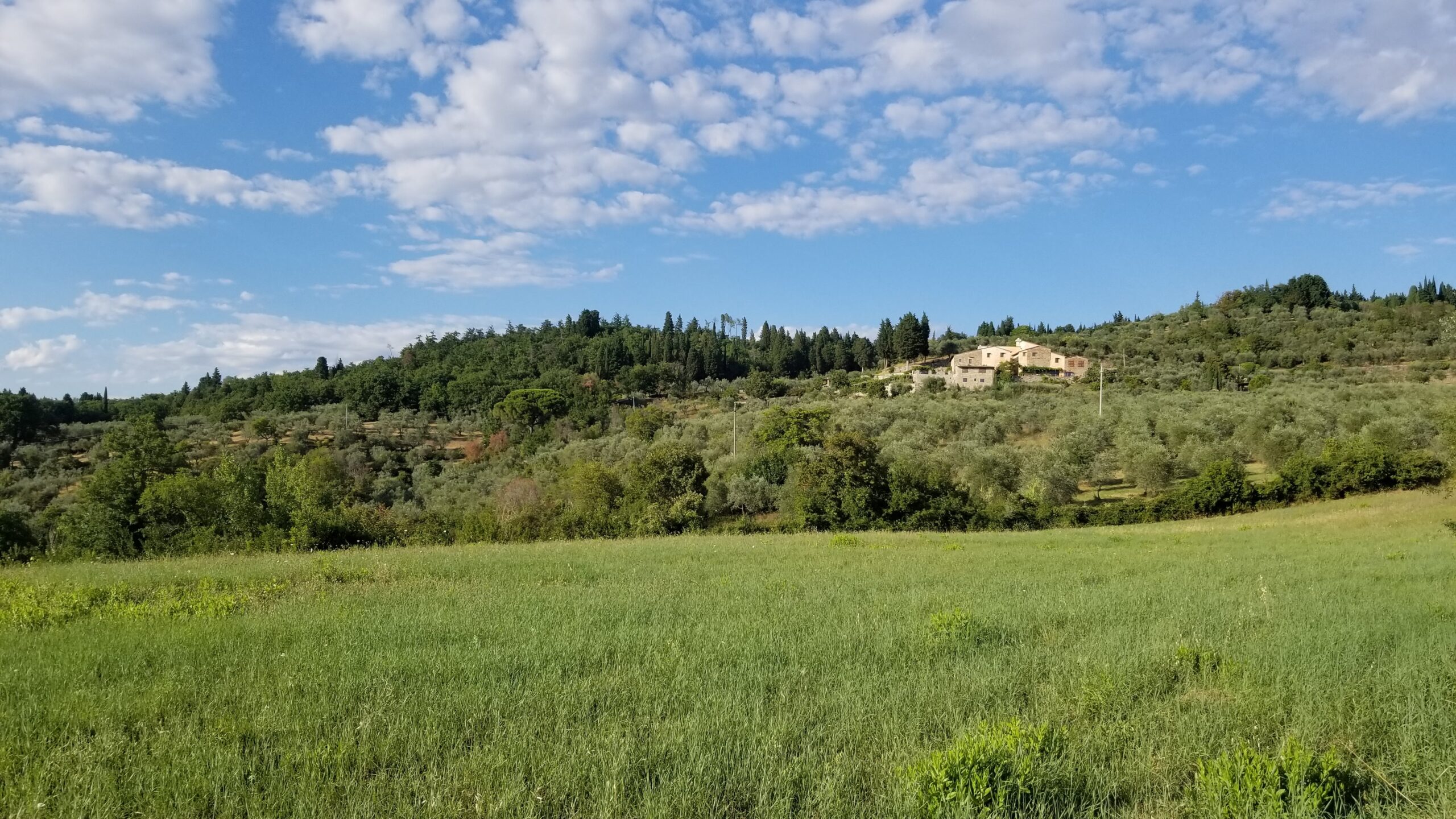
The olive tree teaches this better than many studios do. It is not spectacular in the way of tropical flowers. It does not seduce the eye with excess. Its beauty is in its endurance, its groundedness, its quiet silver steadiness under changing skies. Āsana should make us more like that.
The two wings of āsana: sthira and sukha
Sthira — steadiness
Steadiness is not stiffness. It is integrity.
Think of a cypress tree in the hills above Fiesole. It stands upright, unmistakably itself. It has axis. It has dignity. Yet it is not made of iron. Its firmness is alive.
In practice, sthira means that the posture has direction. The bones are placed intelligently. The muscles participate. The breath is not being crushed. The mind is not leaking everywhere. There is presence.
In modern life, many of us are losing this quality. We slump over desks, bend into screens, lounge into fatigue, and carry ourselves like a sack someone forgot to tie. Then we wonder why our mood is unstable. The body has been rehearsing disorganization all day.
A simple example: someone working in Florence or Milan spends seven hours at a laptop, chest collapsed, chin forward, lower back dull, breath shallow. In the evening they come to practice and ask for peace. Often the first doorway is not mystical. It is architectural. Feet on the ground. Sitting bones rooted. Spine rising. Back ribs breathing. Neck soft. This, too, is yoga.
Sukha — ease
Ease is not passivity. It is spaciousness.
A lake reflects the moon when its surface is unagitated. Not dead, not rigid—simply untroubled enough to receive.
In practice, sukha means there is room inside the posture. Room for breath. Room for sensation. Room for the nervous system not to feel hunted. The face softens. The tongue unwinds. The eyes stop grasping. The pose becomes inhabitable.
Many people misunderstand this. They think ease means doing less, collapsing, switching off, or avoiding effort. But true ease is not the absence of tone; it is the absence of unnecessary struggle. There is still clarity. Still aliveness. Still participation. The violin string must not hang loose, but neither must it be tightened until it screams.
In daily life, sukha may mean how you sit during a difficult conversation. It may mean how you stand in a queue at the post office. It may mean how you drive when traffic thickens around Firenze and the nervous system wants to turn every red light into a personal insult. Āsana begins there too. Can you remain upright without becoming hard?
Āsana in modern life
“Ne’er saw I, never felt, a calm so deep!” — William Wordsworth (The Poetry Foundation)
The most important thing to understand is this: āsana does not begin only when the mat is unrolled.
It begins in the kitchen.
At the desk.
On the train.
In the car.
At the dinner table.
In the way you bend down to pick up a child.
In the way you stand while waiting for your coffee.
In the way you sit when nobody is watching.
A modern example: a person spends all day switching between phone, email, meetings, and social media. The body becomes a field of micro-bracing. The forehead tightens. The shoulders round. The diaphragm forgets its song. Then, in class, that same person tries to “do” a beautiful triangle pose. But the pose will always be carrying the residue of the day. So one of the deepest functions of āsana is not only to shape the body—it is to decondition the posture of stress.
Another example: someone in a yoga studio pushes aggressively into a forward fold because everyone else seems deeper. The hamstrings scream, the breath shortens, the mind compares, and yet they call it devotion. But āsana practiced this way becomes a mirror of the same achievement-hunger that exhausts us in work and relationships. Yoga is not here to decorate that hunger. It is here to liberate us from it.
Āsana here in Italy
Here in Italy, āsana has a very intimate relevance, because life is beautifully embodied here.
There are long meals, warm conversations, shared tables, winding streets, uneven stones, hills, art, beauty, gesturing bodies, and a culture that often lives close to the senses. This is one reason Italy can be such a wonderful place to practice yoga: it reminds us that spirit is not somewhere else. It is here, in lived texture.
But this same richness also asks for balance.
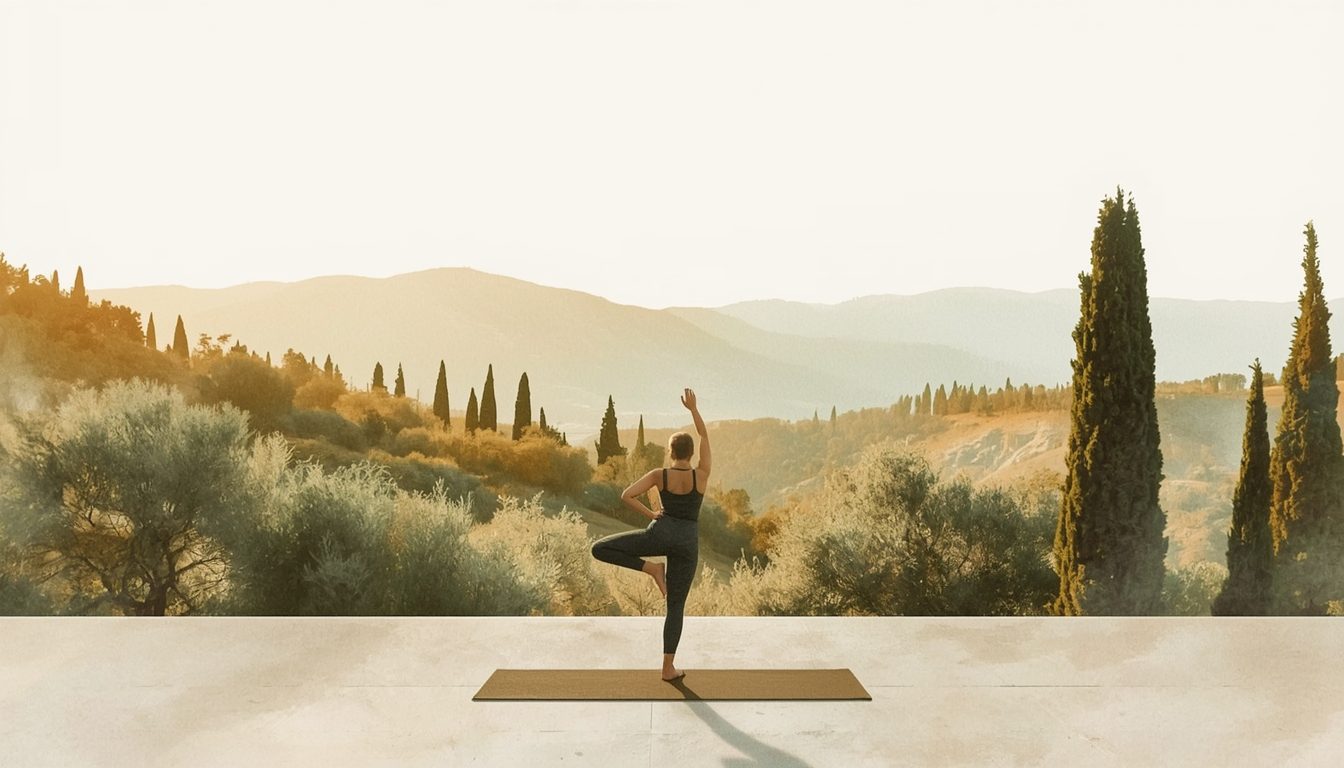
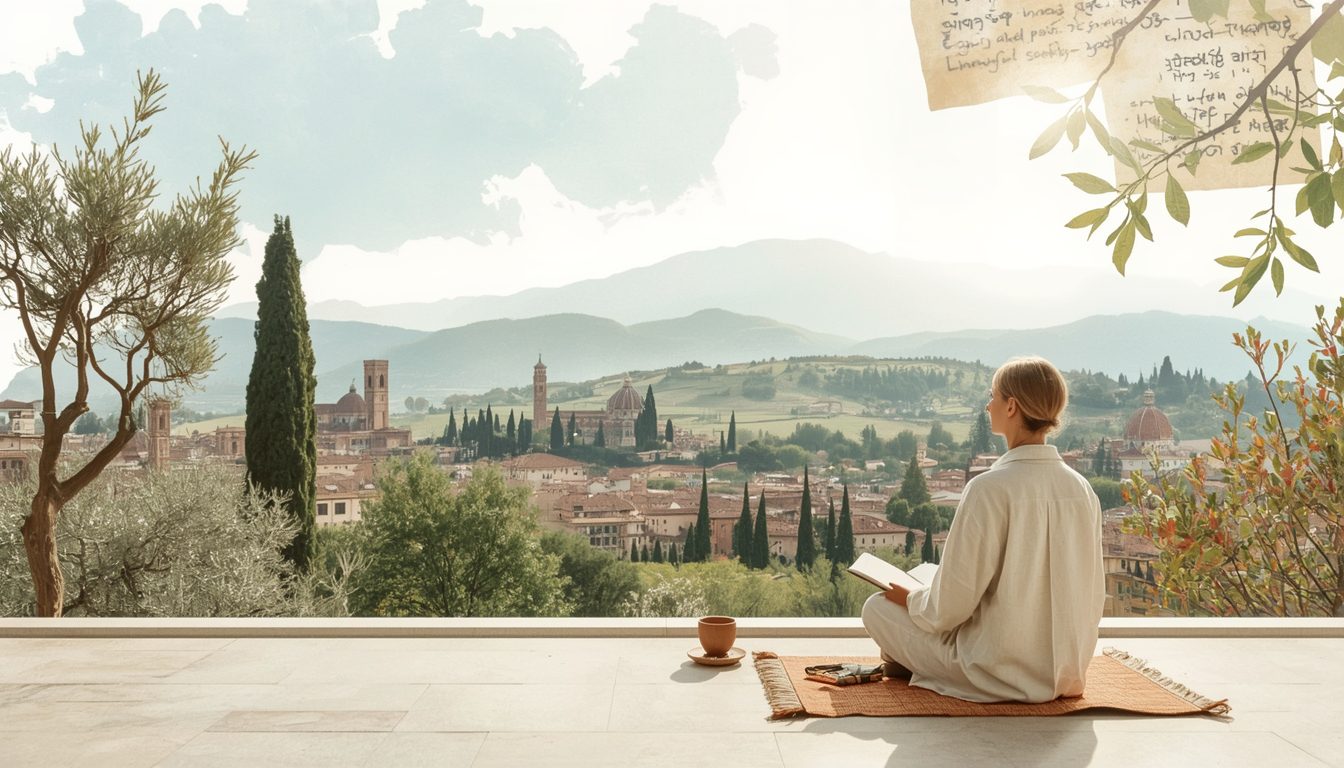
Āsana in Italy may mean learning how to sit at a table for hours without collapsing into the lower back. It may mean walking the cobblestones of an old town with grounded feet and a lifted spine. It may mean recovering from the tendency to fold over the phone while riding the train between towns. It may mean practicing a standing pose on a terrace in Fiesole while the evening light falls over olive groves, not as a photo opportunity but as a conversation with gravity.
It may also mean a different relationship with pleasure. A good meal, a glass of wine, a late evening with friends—these can all be beautiful parts of life. Āsana does not condemn beauty. It teaches digestive intelligence in every sense: how much to receive, how much to release, how not to become heavy in body or mind. A good practice in Tuscany is not one that fights the earthiness of life, but one that learns to stay clear within it.
How to develop āsana in everyday life
Begin small. Begin honestly.
When you sit, sit on purpose.
When you stand, stand through both feet.
When you breathe, let the ribs remember they are doors.
When you practice, stop one breath before ambition takes over.
You do not need to become dramatic about posture. You need to become intimate with it.
Here are a few simple doors into practice:
1. Turn sitting into practice
Each time you sit down—at breakfast, at a desk, on a train—feel the sitting bones, lengthen the spine, soften the jaw, and take three unhurried breaths. Krishna’s image of a steady seat in a clean place becomes astonishingly modern when we remember that our chair, too, can become a field of practice. (Shlokam)
2. Release the excess effort
In any pose, ask: where am I doing more than is needed? Soften the forehead. Unclench the toes. Let the tongue rest. Patañjali’s teaching on relaxing effort is one of the most therapeutic instructions in all of yoga. (Shlokam)
3. Use the breath as truth
If you cannot breathe, you are probably not in āsana anymore. You may be in acrobatics, ambition, fear, or self-image—but not in yoga.
4. Practice steadiness in ordinary moments
Waiting at the farmacia. Standing at the espresso bar. Pausing before entering the house after a difficult workday. These are excellent places to practice upright softness.
5. Let the pose end before the ego wants applause
A mature posture is one you can leave without regret. Better one honest minute than ten theatrical ones.
A Western parallel: Aristotle, Stoicism, and embodied poise
“…thou wilt find calm, everything stable, and a waveless bay.” — Marcus Aurelius (Internet Classics Archive)
There is a beautiful bridge here to Western philosophy.
Aristotle describes virtue not as mindless routine but as an active condition, a stable equilibrium of the soul—not rigidity, but a poised state from which right action can arise. That image resonates deeply with āsana. A good posture is not frozen. It is balanced from within. It can receive movement without losing center. (Internet Encyclopedia of Philosophy)
The Stoics, too, treated philosophy as training for daily life, and the tradition emphasizes practice and the discipline of desire—learning to want what reality actually allows instead of fighting the cart of existence. That inner training echoes Patañjali’s promise that through mature āsana we become less struck by the dualities. Marcus Aurelius’ image of finding “a waveless bay” is, in its own Roman way, a cousin to yogic steadiness. (Internet Encyclopedia of Philosophy)
So the comparison is not forced. In yoga, the body becomes a seat of stillness. In Aristotle, the soul learns stable equilibrium. In Stoicism, the mind learns composure within reality. All three distrust chaos masquerading as freedom. All three point toward a human being who is collected rather than scattered.
The deeper purpose of āsana
The highest purpose of āsana is not flexibility. It is availability.
Availability to breath.
Availability to attention.
Availability to prayer.
Availability to life as it is.
When posture matures, the body stops shouting so loudly. It becomes less of a battlefield and more of a shrine. This does not mean pain vanishes or aging disappears. It means we stop living in constant argument with embodiment.
Āsana is the body learning reverence.
Not reverence as self-obsession.
Reverence as participation.
Reverence as alignment.
Reverence as the willingness to become a worthy seat for consciousness.
That is why one sincere mountain pose may be more transformative than fifty distracted postures. That is why a quiet seated pose at dawn may teach more than a room full of mirrors. That is why the elderly practitioner who breathes with dignity may sometimes be closer to yoga than the athletic one who bends like water but lives like fire.
Begin gently…
Do not try to become an ideal yogi by next Thursday.
Begin where you are.
- Sit better.
- Stand softer.
- Breathe lower.
- Force less.
- Listen more.
- Let the body learn trust.
Over time, āsana becomes less like arranging furniture and more like tuning an instrument. The strings of the body, the breath, and the mind begin to sound together. And in that quiet tuning, meditation no longer feels so far away.
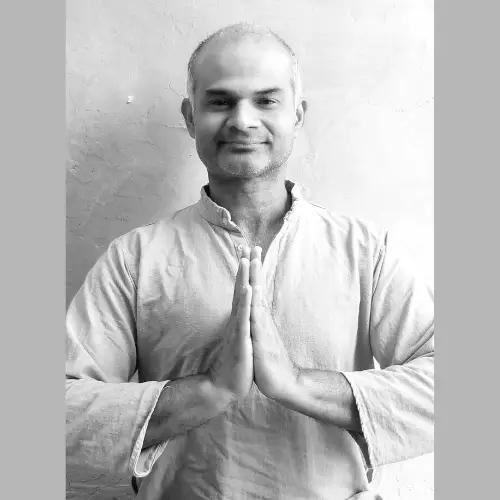
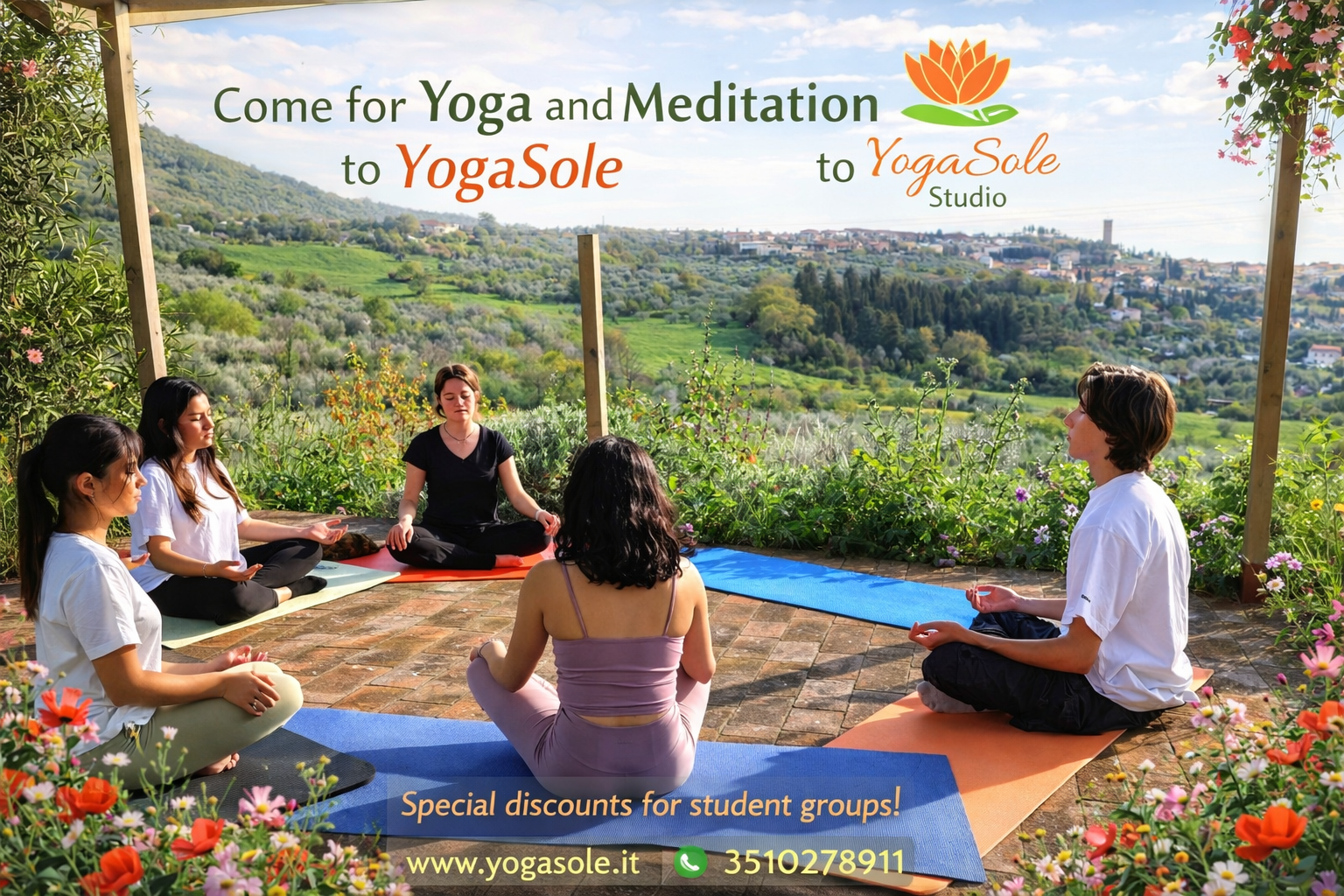
To learn and experience the wisdom of the Vedas with Aroonji—an experienced yoga teacher, Ayurveda consultant, life coach, and spiritual guide, born and raised in the heart of India and shaped by life and teaching across three continents—you are warmly welcome. He offers private sessions for individuals and groups, and you can also join the existing community at YogaSole in Fiesole, where the current contact details listed are yogafiesole@gmail.com and +39 3510278911. (Aroonji)
So perhaps the real question is not, How advanced is my pose?
Perhaps it is this:
Does the way I sit, stand, breathe, and move make me a more peaceful place for my own soul to dwell?
0 Comments