
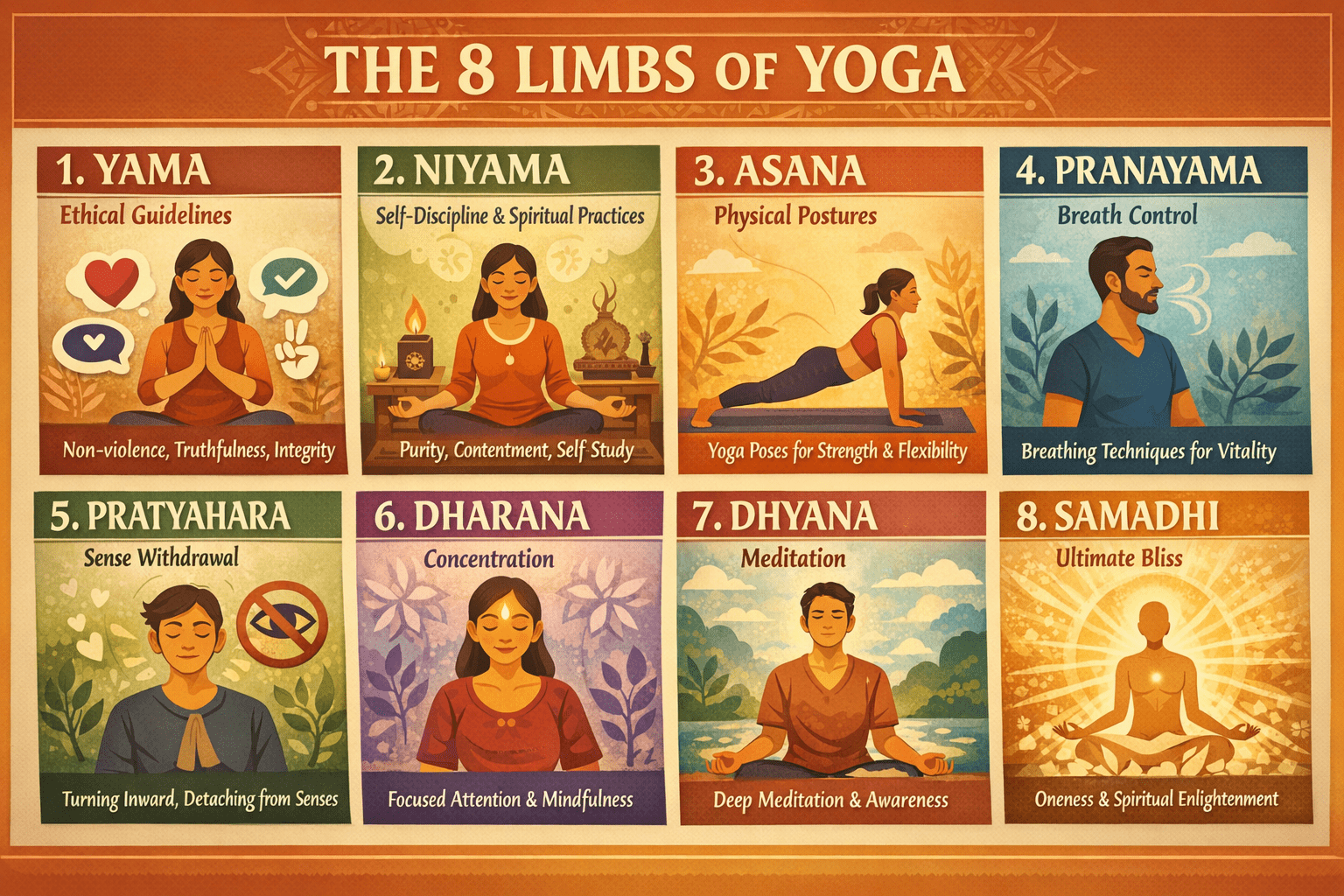
Yoga, a profound path to self-realization, is beautifully laid out in the ancient text, the Yoga Sutras of Patanjali. Here, yoga is described as an eightfold path—eight limbs—that guide us toward harmony of body, mind, and spirit. These limbs are not just physical postures but a comprehensive way of living, rooted deeply in the wisdom of the Vedas and Upanishads. Let us embark on a soulful exploration of these eight limbs, weaving metaphors, ancient verses, and modern-day examples to illuminate their timeless relevance.
- Yama: The Ethical Compass
The first limb, Yama, represents ethical restraints—universal moral codes that shape how we relate to the world. Think of Yama as the roots of a tree, grounding us firmly in integrity and compassion. The Vedas echo this in the concept of ‘Dharma,’ our righteous duty to live truthfully. For example, Ahimsa, or non-violence, teaches us to cultivate kindness in thought and action. In today’s world, practicing Ahimsa could mean choosing words carefully on social media or showing patience in traffic—small acts that ripple peace outward.
- Niyama: The Garden of Self-Discipline
Niyama refers to personal observances—the inner garden we tend with discipline and self-care. It’s like nurturing a delicate flower within ourselves, allowing it to blossom through purity (Shaucha), contentment (Santosha), and self-study (Svadhyaya). The Upanishads invite us to “know thyself,” emphasizing Svadhyaya as a path to deeper awareness. In modern life, this might look like setting aside time for meditation or journaling, fostering inner clarity amid daily chaos.
- Asana: The Poise of the Body
Asana, the third limb, is often what people first associate with yoga—physical postures. But beyond exercise, asanas are the dance of balance and steadiness in our bodies. Imagine your body as a temple; asanas are the artful arrangements that honor this sacred space. Ancient texts describe asana as a seat steady and comfortable for meditation. Today, maintaining a regular practice helps us cultivate strength and flexibility to face life’s challenges with grace.
- Pranayama: The Breath of Life
The fourth limb, Pranayama, is the regulation of breath—the invisible thread weaving body and mind together. Just as wind stirs leaves on a tree, breath moves energy within us. The Rig Veda celebrates Prana as the vital force sustaining all life. Breathing consciously in stress-filled moments—like before a big presentation—can calm the mind and recharge our spirit, reminding us that each inhale brings renewal.
- Pratyahara: The Inner Withdrawal
Pratyahara means withdrawal of the senses—turning inward like a turtle retreating into its shell. This limb teaches us to detach from distractions and external stimuli. The Upanishads describe this as mastering the senses so they no longer control us but serve our higher purpose. In our tech-saturated era, Pratyahara might be taking mindful breaks from screens or turning off notifications to reconnect with our inner voice.
- Dharana: The Focused Mind
Dharana is concentration—fixing the mind on a single point like a lamp steady against the night’s breeze. It’s training the mind to hold attention without wavering. The Bhagavad Gita praises such focus as essential for spiritual progress. Practically, Dharana could be seen in activities like mindful reading, focused work sessions, or even savoring a meal without distraction—moments where presence becomes our anchor.
- Dhyana: The Flowing Meditation
Building upon Dharana comes Dhyana—meditation itself—a flowing state where concentration transforms into uninterrupted awareness. Picture a river that moves effortlessly without resistance; Dhyana is that serene stream of consciousness. Ancient sages described it as the gateway to union with the divine self. In modern terms, this might be the quiet moments during meditation when thoughts fade and stillness prevails.
- Samadhi: The Blissful Union
The final limb, Samadhi, is the ultimate state of blissful absorption where individual consciousness merges with universal consciousness. It’s like the ocean embracing all rivers—boundless and infinite. The Upanishads call this realization ‘Tat Tvam Asi’—“Thou art That,” affirming our inherent unity with all existence. While elusive, glimpses of Samadhi can arise in moments of profound joy or deep connection, inspiring us on our journey.
In embracing these eight limbs—Yama, Niyama, Asana, Pranayama, Pratyahara, Dharana, Dhyana, and Samadhi—we honor an ancient roadmap that guides us toward balance and enlightenment. Their wisdom transcends time, inviting us to live with integrity, awareness, and love in every breath and step we take today. Through this sacred practice, we weave together past and present into a harmonious dance of life itself.
0 Comments